Turning Volatility into Control:
Energy-led disruptions are now structural. For fertiliser players, the edge lies in deploying capital efficiently across procurement, inventory, and supplier payments.
Winners will absorb volatility without locking liquidity, building resilience into working capital.
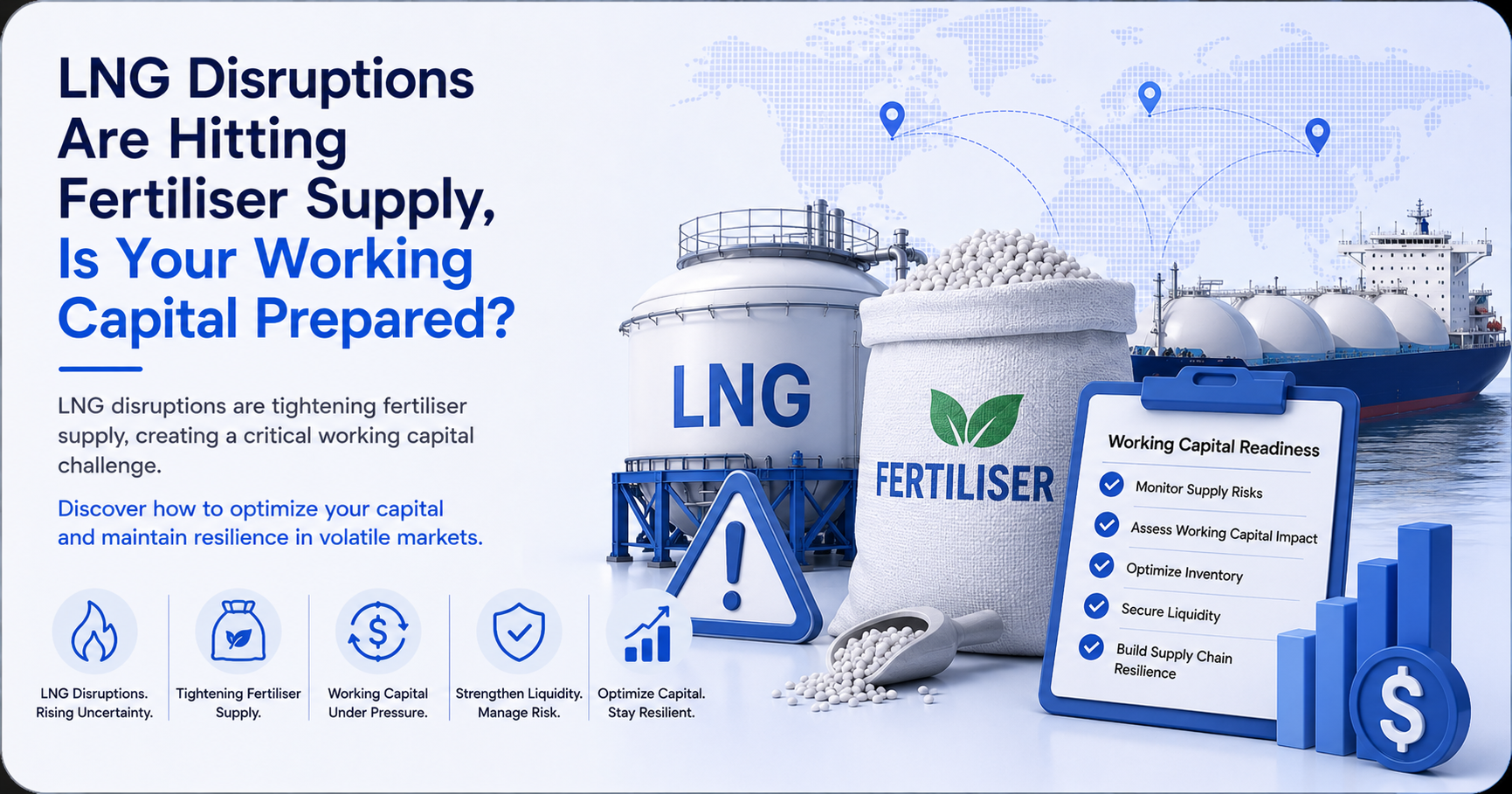
Recent disruptions in LNG (liquefied natural gas), a key input for ammonia production, across South Asia are starting to have a visible impact, with multiple upstream plants shutting down, tightening supply across key fertilisers like urea, ammonium-based products, DAP, and nano DAP.
For fertiliser companies, this isn’t just an operational issue, it’s quickly becoming a working capital challenge.
What This Means for Fertiliser Players
- Production disruptionsare tightening supply of key inputs like ammonia (NH₃) and downstream products like urea (CO(NH₂)₂), creating uncertainty in fulfilment timelines
- Input cost volatility is increasing sharply, with gas-linked pricing becoming harder to predict
- Higher reliance on imports of ammonia and intermediates is adding pressure through longer cash conversion cycles
- Advance payments and supplier constraints are locking up liquidity earlier than planned
- Inventory strategies are shifting, from stockpiling to just-in-time, but without the right financing structures
The Real Impact
Margins come under pressure, liquidity gets tighter, and planning becomes reactive instead of strategic.
Where Great Kapital Can Help
We work with companies navigating exactly these kinds of disruptions by restructuring how working capital is deployed:
- Extended Payables for Imports: Manage higher import dependence with stretched payment cycles, without stressing existing banking lines
- Off-Balance-Sheet Inventory: Hold critical raw materials or finished goods on your behalf, so you can maintain supply without blocking capital
- Supplier Liquidity Support: Ensure upstream stability even when suppliers are facing cost or energy shocks
- Cross-Border Trade Structuring: Navigate volatility in global sourcing with built-in credit and compliant structures.
What This Enables
- Maintain supply continuity despite production disruptions
- Absorb input cost shocks without immediate liquidity strain
- Stay responsive in a volatile pricing and sourcing environment
In a market where supply shocks can quickly translate into financial stress, how working capital is structured often becomes the differentiator.
If this is something you're currently navigating, happy to share how others in the sector are approaching it.